Bleeding Heart Flower Meaning: Dicentra Symbolism, Colors & Legends
In 1846, the Scottish plant hunter Robert Fortune shipped a crate of unfamiliar roots back to the Royal Horticultural Society in London.
One of them opened the following spring into a row of pink lockets hanging from a bent green wire.
British gardeners lost their minds a little.
Within a decade the plant was in nearly every cottage border in England, and it had collected a pile of nicknames: Lady in a Bath, Dutchman's trousers, lyre flower, and the one that stuck — bleeding heart.
The name is doing a lot of work. A heart, pierced, dripping a single white drop.
That image is why this flower carries one of the most specific messages in the whole language of flowers: love that keeps going after it has been turned down.
Here is what each color says, where those meanings came from, and when it is actually a good idea to give someone a plant named after a wound.

🌸 Flower Profile
| Scientific Name | Lamprocapnos spectabilis (formerly Dicentra spectabilis); related species remain in Dicentra |
| Family | Papaveraceae (the poppy family) |
| Origin | Northern China, Korea, and Siberia for the classic species; North America for the native fringed and Pacific types |
| Blooming Season | Mid to late spring, roughly April through early June, with a second flush in cool summers for the native species |
| Primary Meaning | Undying love, devotion that survives rejection, and tender compassion |
Color Meanings
Table of Contents
- 1. Pink and White (the classic bicolor)
- 2. Pure White
- 3. Crimson and Deep Red
- 4. Golden Yellow
- 5. Mauve and Rosy Lavender
- 6. Deep Magenta and Purple-Rose
- 7. Chartreuse Gold Foliage with Pink Hearts
1. Pink and White (the classic bicolor)
Meaning: Love that refuses to die, even unreturned

💡 At a Glance
Shade Variations: The bicolor runs through a surprising range.
Pale blush forms fade almost to cream at the tips and read as gentle, early, uncertain affection — the first-crush end of the spectrum.
Deep rose forms such as the one sold as Rosea hold saturated color right to the lip, and carry a heavier, more committed tone.
The cultivar Gold Heart keeps ordinary pink flowers but hangs them over chartreuse foliage, which pushes the pink toward coral and makes the whole plant read as warmth rather than sorrow.
One quiet detail: the white inner petals darken to ivory as the flower ages. Florists call it the tear going cold.
Stems & Styling: Bleeding heart does not behave like a rose, so stop trying to make it stand up.
- Cut three, five, or seven arching stems — odd numbers let the arcs cross instead of colliding. Three stems is the traditional count for a message of steady affection.
- Use a low, wide vessel: a footed bowl, a creamware jug, a shallow compote. The stems want to spill sideways and drip.
- Pair with ferns, hellebores, Solomon's seal, or forget-me-nots. All three bloom in the same shade conditions and none of them compete for attention.
- Add white tulips if you need height. The vertical line makes the hearts look like they are hanging from something.
- Sear the cut ends in boiling water for ten seconds before arranging. The sap bleeds and the stems wilt fast without it.
Start with the shape, because the shape is the whole argument.
A bleeding heart stem does not hold its flowers up. It bends.
The blooms hang in a single line along the underside of that arch, each one identical, each one facing the ground.
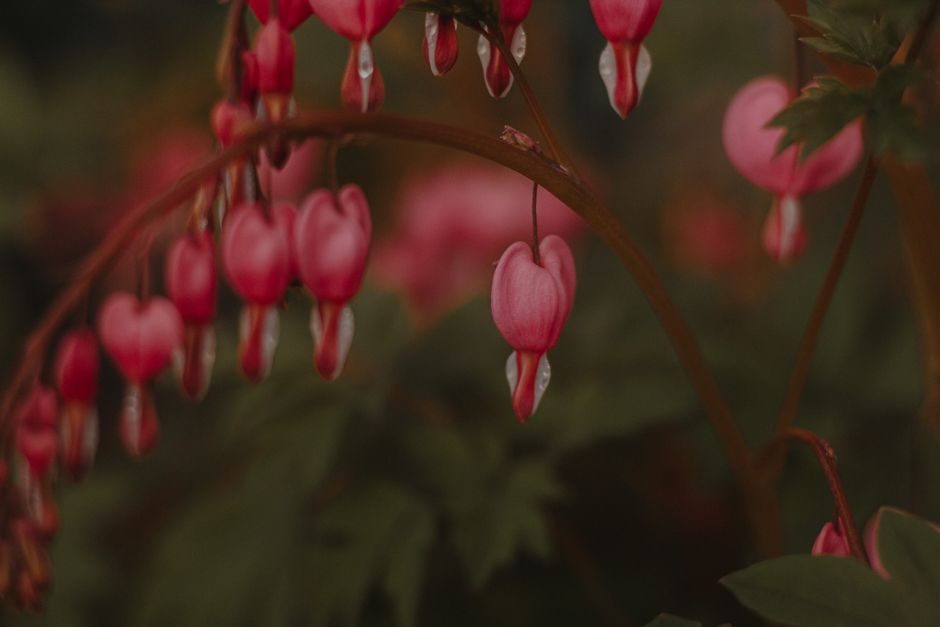 Victorian flower dictionaries loved this plant for a reason. They needed a bloom that meant something very particular, and nothing else in the garden meant it.
Roses said passion. Lilies said purity. Violets said modesty.
But there was no accepted flower for loving someone who has already said no.
The bleeding heart filled the gap. Its message was devotion without hope of return.
That is a strange thing to send in a posy, and yet people did. The flower appears in pressed albums, in mourning wreaths, and in the margins of diaries from the 1860s onward.
 The hand-trick is the part most people remember once they have seen it.
You take one bloom and you dismantle it into rabbits, slippers, earrings, and a dagger.
It takes about fifteen seconds. Children find it close to magic, and adults find it faintly disturbing once they realize the story ends in a suicide.
My own view is that the tale survived because it gives children a safe way to handle an unsafe idea. Love can be refused. That refusal can hurt enormously. Here is a flower that admits it.
 There is also the matter of the other name. Turn a bloom upside down and the two outer petals flare into a tub while the inner white petals become a small figure sitting in it.
Hence Lady in a Bath, a nickname recorded in English gardens before the bleeding heart label took over.
Same flower. Completely different mood. One is a tragedy and the other is a joke about a woman having a soak.
I think the plant is better for holding both.
If you are planting it, give it morning sun and afternoon shade, and accept that the whole thing will go yellow and vanish by midsummer.
That disappearance is not a failure. It is the plant going dormant on purpose, having said what it came to say.

2. Pure White
Meaning: Remembrance, grief carried gracefully, and honest innocence> 💡 At a Glance
Shade Variations: White here is rarely pure white.
Cool green-white forms carry a faint lime cast in the outer petals, especially in deep shade, and read as fresh rather than funereal.
Ivory and cream forms warm up in full morning sun and feel older, softer, more like memory than loss.
Alba with pale green stems gives the cleanest effect and photographs best against dark foliage.
Watch for a thin pink line at the petal tip on some seedlings. That trace of color is the giveaway that your Alba is not a true white, and it changes the message to something more hesitant.
Stems & Styling: White bleeding heart is one of the few genuinely graceful sympathy flowers that is not a lily.
- Keep it monochrome. White stems with white hellebore and white Solomon's seal, nothing else. Color breaks the tone.
- Five stems is the traditional sympathy count in Anglo-American floristry — enough to feel considered, not enough to feel showy.
- For a funeral or memorial table, lay stems flat along the surface rather than standing them up. The arcs make a line that reads like handwriting.
- Pair with silver-grey foliage such as lamb's ear or dusty miller if you need weight.
- Avoid baby's breath. It turns the whole thing into a supermarket bouquet and flattens the gesture.
White Alba looks like the pink form with the volume turned down.
It is not. It behaves differently in the eye.
In deep shade, pink bleeding heart disappears into the brown of the soil. White does the opposite. It floats.That glow is why the Victorians put it in graveyards. A north-facing plot gets no direct sun, and most flowers sulk there.
Alba flowers anyway, and then it lights up the dark corner like a row of small lamps.
The symbolism followed the horticulture. It usually does.
I find the white form harder to give than the pink one, because the message is less flattering and more honest.
Pink says I still love you. White says I remember, and I am not going to make a scene about it.
That second sentence is the harder one to say out loud.If someone has lost a parent, this is the plant I recommend over a cut arrangement nearly every time.
A bouquet asks to be looked at for a week and then thrown away.
A crown of Alba in the ground asks nothing, disappears in July, and shows up again in April when the person has probably stopped expecting anything to.One caution worth naming. Do not pair white bleeding heart with bright yellow.
Daffodils overlap in bloom time and they will bully it completely. The arcs need quiet neighbours or they read as mess.
Stick to green, white, and silver. Let the shape do the talking.---
3. Crimson and Deep Red
Meaning: Passionate love that has cost something; a wounded, unapologetic heart> 💡 At a Glance
Shade Variations: Red in this genus splits into two distinct families.
Cherry and true crimson, as in Valentine, sit bright and clean against dark stems. These read as declaration.
Oxblood and burgundy, found in some of the hybrid strains, go nearly brown in low light and read as grief rather than passion.
Carmine-pink intermediates blur into the classic bicolor and are the ones most often mislabeled in garden centres.
The stem color matters as much as the flower. Burgundy stems make red read as serious. Green stems make the same red look cheerful.
Stems & Styling: Red bleeding heart is the best answer I know to the problem of the predictable Valentine's bouquet.
- One single arching stem in a bud vase outperforms a dozen roses for anyone who gardens. It is unexpected, and it is unmistakably a heart.
- For a full arrangement, hold at three stems maximum and let dark foliage carry the bulk. More than three and the red stops being a statement and becomes decoration.
- Pair with dark heuchera leaves, black hellebore, or purple honesty. Avoid pink companions, which make the red look faded.
- Bloom time is the catch: red bleeding heart flowers in April and May, not February. For an actual Valentine's gift, give a dormant bare-root crown in a box with a photograph of what it will do.
- Twelve stems is a bad idea. Twelve arcs in one vessel looks like a tangle of fishing line.
The first time I saw Valentine in flower I thought someone had painted it.
The red is not subtle. It is pillar-box bright against stems the color of dried wine.What the color does to the meaning is interesting. The pink form is wistful. It hangs its head and accepts rejection.
Red does not accept anything. It looks like a heart that has been through the mill and is still beating loudly about it.
I would give red bleeding heart to a couple who nearly did not make it and did.
There is a practical reason florists have not embraced it, and it is worth knowing before you order any.
The stems bleed heavily when cut, and they wilt within hours if you do not seal them.
Sear the ends in just-boiled water for ten seconds, then plunge straight into cold water. Done properly you get five or six days. Done carelessly you get an afternoon.The Valentine's Day problem is real and there is only one honest solution.
The plant flowers in late April. February gifts have to be dormant crowns.
So you hand over a box of brown roots and a photograph. It feels like a terrible gift for about four seconds, and then it becomes a much better one than roses, because it arrives again next year and the year after.One more note on placement. Red bleeding heart burns in afternoon sun faster than the pink form does.
Give it the east side of a wall, decent leaf mould, and water in its first summer.
Get that right and it will hold color for three weeks. Get it wrong and the red fades to a muddy rose by week two.---
4. Golden Yellow
Meaning: Resilience after disaster; hope that arrives on scorched ground> 💡 At a Glance
Shade Variations: Yellow in this group runs warmer and brassier than most garden yellows.
Clear lemon appears in young flowers and fades fast.
Deep golden-ochre develops as blooms age, and on a mass of plants the two tones overlap into something closer to flame.
The cultivated hybrid King of Hearts and its relatives offer pale primrose and cream-yellow tints on a much smaller plant for those who want the color without the chaparral.
Foliage adds a third note: golden eardrops carries blue-grey, almost ferny leaves, so the yellow sits on silver rather than on green.
Stems & Styling: Yellow bleeding heart relatives are rarely sold cut, so treat this as a planting and photography flower first.
- If you do cut it, go tall and sparse. Three stems of golden eardrops in a narrow glass cylinder, nothing else. The plant is six feet tall in the wild and it resents being crowded.
- Pair with California poppies, blue ceanothus, or grey artemisia for an honest west-coast palette.
- The chartreuse-foliage cultivar Gold Heart gives you the yellow note without the wild species. Combine its leaves with pink blooms for a warm, lit effect in a shaded corner.
- For a gift with meaning attached, give seed rather than stems and explain the fire habit. The story is the present.
- Skip white companions. Yellow and white here looks accidental rather than designed.
Golden eardrops does not look like a bleeding heart until you get close.
The plant is tall, grey-leaved, and slightly scruffy. The flowers are small yellow sacs held upward on branching spikes.Then you look at a single bloom and the family resemblance lands. Two outer petals, two spurs, that same odd locket construction.
This is the same architecture as the pink flower in your grandmother's border, built for a hillside at forty degrees Celsius.
The fire story is the part worth carrying around.
This seed can lie in soil for a decade or more and do nothing.
It needs heat, or smoke, or the simple absence of competition that follows a burn. Then it comes up by the thousand.I am wary of pushing that into a tidy lesson about hope, because the ecology is messier than the metaphor.
The yellow display lasts a season or two. The chaparral grows back and the eardrops go quiet again underground.
But I keep coming back to one detail. The seed was already in the soil before the fire. The recovery was not sent for. It was present the entire time, including during the worst of it.For most gardens, growing the true wild species is a losing battle. It wants poor dry soil, hates being watered, and dislikes pots.
The practical substitute is the chartreuse-leaved cultivar Gold Heart, which gives a shaded bed a yellow glow all season and still hangs pink hearts in May.
Different plant, same effect on a dark corner.---
5. Mauve and Rosy Lavender
Meaning: Quiet persistence; love expressed in small repeated acts rather than declarations> 💡 At a Glance
Shade Variations: The native colors are muted on purpose and they repay close looking.
Dusty mauve is the baseline for eximia — a pink with grey folded into it.
Rose-lavender, seen in the hybrid Luxuriant, leans cooler and holds up better in heat.
Pale shell pink, common in wild formosa, almost reads as white from three steps away.
Deep magenta-mauve appears in selected forms and is the only one that will carry across a large garden.
All of them sit over blue-green, deeply divided foliage that looks like a fine fern, which is why these plants earn their keep long after flowering stops.
Stems & Styling: Fringed bleeding heart is the most useful of the family for actual cutting, because there is always more of it.
- Cut seven to nine short stems and bunch them tightly in a small jug. The flowers are small, so density beats arching drama here.
- Include the foliage. The lacy blue-green leaves are half the plant's value and most people leave them in the garden.
- Pair with columbine, wild geranium, and Virginia bluebells for a native woodland posy that looks like it was gathered rather than bought.
- Because it reblooms, this is the right choice for recurring gestures: a small jar on a kitchen table every few weeks through spring and summer.
- Keep arrangements under about twenty centimetres tall. Scale it up and the delicate flowers simply vanish.
Most people meet the Asian bleeding heart first and assume that is the whole genus.
Then they meet fringed bleeding heart and have to recalibrate.
It is smaller, scruffier, and far more useful.The flowers are narrow mauve lockets rather than plump pink ones. They are held above the leaves in loose sprays.
From a distance the plant reads as a grey-green fern with a pink haze over it.
And it does not stop. That is the headline.
The European species gives you three glorious weeks in May and then turns yellow and disappears.
Eximia flowers in April, slows in July heat, and starts again in September if you keep it damp.I have come to think the native species carry a better version of the symbolism.
A pierced heart is a dramatic image, and drama is easy. One grand gesture, one refusal, one dagger.
The mauve flowers are what devotion actually looks like. Small. Repeated. Slightly unremarkable. Still there in September.The ant story is my favourite fact about this plant and I bring it up at dinner parties against all advice.
Each seed has a small fatty packet attached. Ants want the fat, so they haul the seed back to the nest, strip the packet off, and throw the seed out on the colony rubbish heap, which is rich, loose, and perfect for germination.
The plant has outsourced its entire dispersal and planting operation to insects who think they are the ones being served.If you garden in eastern North America and want one bleeding heart, I would plant this one over the famous pink.
It is local, it feeds native bumblebees, and it will still be flowering when the showy cousin has packed up for the year.
6. Deep Magenta and Purple-Rose
Meaning: Intense feeling that has been transformed rather than resolved; grief turned into something usable> 💡 At a Glance
Shade Variations: Magenta is unstable in this genus, which is part of its appeal.
Purple-rose is the baseline for Bacchanal, dark enough to disappear in deep shade.
Hot fuchsia appears in the vigorous modern hybrids and holds its color in brighter light.
Wine-magenta forms shift toward brown as the flower ages, giving a single plant two tones at once.
The same plant can read as purple in morning light and clear pink by late afternoon. Soil acidity and heat both nudge it. If you need a reliable color, this is not the group to pick.
Stems & Styling: Magenta needs managing or it takes over whatever it is put into.
- Keep it to a single accent: one or two magenta stems inside an arrangement built from greens, whites, and greys.
- Pair with lime green — euphorbia, alchemilla, or young fern fronds. The complementary clash is the point and it is genuinely striking.
- Avoid orange and avoid scarlet. Both fight magenta and nobody wins.
- For a gift after a loss some months old, this is a better choice than white. White says I am being respectful. Magenta says I know you are still angry about it.
- Dark glass or matte black vessels suit it. Clear glass makes the stems look thin.
Magenta is the color most people ask for once they have grown ordinary pink for a few years.
Pink is lovely and pink is quiet. In a shaded bed it can get swallowed.
Magenta does not get swallowed.What surprises people is how much the color moves.
Same plant, same week. Purple at eight in the morning, bright rose by five in the afternoon.
Soil chemistry and temperature both push it around, and a hot spring will shift the whole clump toward fuchsia.
I have stopped treating that as a defect. A flower whose color depends on the day it is looked at is a reasonable symbol for a feeling that will not settle.The Bacchanal name is worth a moment. Roman bacchanalia were not simply parties.
They were rites where mourning and ecstasy were handled together rather than kept in separate rooms.
That is a fair description of the second year after a loss, when people are expected to be finished and are not.
Magenta suits that stage much better than white does.For planting, the trick is the companion color. Magenta against mid-green does nothing. Magenta against lime is electric.
Put it beside a euphorbia or a mound of alchemilla and the whole corner wakes up.One honest warning. The darkest magenta forms genuinely vanish in deep shade.
If your garden is north-facing and gloomy, grow the white instead and save the magenta for a spot that gets two hours of morning sun.
The color only pays for itself where there is light to catch it.
7. Chartreuse Gold Foliage with Pink Hearts
Meaning: Love that brightens a difficult place; warmth brought deliberately into shade> 💡 At a Glance
Shade Variations: The foliage itself shifts through a season.
Acid chartreuse in early spring, when shoots emerge almost apricot at the tips.
Clear golden-green through flowering in May.
Soft lime by June, as the leaves mature and before dormancy.
The pink flowers read differently against each stage. Against acid spring foliage they look coral and hot. Against June lime they look cool and faded.
Too much direct sun scorches the leaves brown at the edges, so the gold is only reliable in shade — which is the entire point of the plant.
Stems & Styling: This is a foliage crop as much as a flower, and it is badly underused in arrangements.
- Cut stems with leaves attached and let the chartreuse do the work. Three flowering stems plus two leaf stems makes a complete arrangement with nothing else added.
- Pair with magenta or deep purple flowers. Chartreuse is the natural companion to both and makes them vivid.
- It is an excellent housewarming gift for anyone who has just inherited a dark basement flat garden or a north-facing courtyard. Give the plant with a note about where to put it.
- In the garden, plant it where low morning light hits it sideways. Backlit chartreuse leaves are the single best effect this plant produces.
- Do not combine with yellow flowers. The gold foliage already fills that role and the result is muddy.
There is a specific problem this plant solves and most gardeners have it.
A shaded bed where everything is green. Different greens, good plants, all of it quietly invisible.Gold Heart breaks that. The foliage comes up in March almost apricot, turns acid chartreuse by April, and holds lime until it goes dormant.
From across a garden it looks like somebody left a light on.
The flowers are an afterthought, and I mean that kindly. They are the ordinary pink and white hearts, the ones Fortune brought back in 1846.
Against the gold leaves they read coral instead of pink. The same flower, warmed up by its own foliage.The one effect worth planting for deliberately is backlighting.
Put Gold Heart where early or late sun comes in low and sideways, not overhead.
The leaves go translucent. For about forty minutes a day in May the plant looks lit from inside.Two honest limitations. It scorches in afternoon sun, going brown and crisp at the leaf margins within a week of a heatwave.
And it grows more slowly than the plain species, because gold leaves carry less chlorophyll and the plant has less to work with.
So it stays smaller, takes longer to form a decent clump, and needs a bit more patience.I still rate it as the most giftable member of the family.
If somebody has just moved into a flat with a dark, hopeless scrap of garden, this is the plant to hand over.
The message is reasonably clear without having to be explained. Here is something that makes light where there is not any.
Gift Guide by Occasion
1. Sympathy and memorial
Send a potted or bare-root crown of the white Alba form rather than cut stems. Cut flowers last under a week and arrive during the worst of it, when nobody has the attention for a vase. A crown planted in autumn or early spring flowers the following April without any care, and the return is the part that matters. Include a short written note about where it likes to grow — north-facing, leaf mould, no full sun — so the gift carries instructions rather than obligations. If you must send cut flowers, five white stems laid flat on a memorial table beside white hellebore, no filler, no baby's breath.
2. A farewell, a goodbye, or love that is not returned
This is the one occasion where the flower's literal Victorian meaning is the gift. Three stems of the classic pink and white form in a plain jug, with a handwritten card naming the meaning outright: devotion that outlasts rejection. Do not pair it with roses, which muddles the message into romance. Do not send it to someone who has asked for no contact — the flower is honest, not an override. It works best as a gesture at a genuine parting: a colleague moving abroad, a friendship closing, a relationship ending on decent terms.
3. Mother's Day and gifts for a parent who gardens
Bleeding heart is in flower across most of Britain and the northern United States for the second Sunday in May, which makes it one of the few genuinely seasonal Mother's Day options. Give a potted plant in bud, not in full flower — it will open at home over the following week instead of peaking in the car. The chartreuse-leaved Gold Heart is the strongest choice for anyone with a shaded garden. For a mother who does not garden, cut three stems, sear the ends in boiling water for ten seconds, and arrange in a low bowl with fern fronds.### 4. Housewarming for a dark flat, basement, or north-facing courtyard
Most housewarming plants assume a sunny windowsill. Bleeding heart assumes the opposite, which makes it unusually useful. Give Gold Heart for its glowing foliage or the native fringed bleeding heart for its long flowering season. Pot it up in advance in a container that suits the recipient's actual space, rather than handing over a nursery pot and a problem. Add a one-line card: morning sun, afternoon shade, water through the first summer, do not panic when it disappears in July.
5. Valentine's Day, for someone tired of roses
The red Valentine cultivar is the most literal heart in horticulture and the name is not an accident. The scheduling problem is that it flowers in late April, not February. Solve it by giving a dormant bare-root crown in a box with a printed photograph of the flowering plant and the planting date written on the card. Plant it together that weekend. It costs a fraction of a dozen roses, it arrives again every spring, and for anyone who gardens it reads as considerably more thought than a florist's standing order.
6. A long anniversary, especially one that survived something
Use the deep red or magenta forms rather than pink. Pink carries the meaning of unreturned love, which is the wrong note for a marriage of twenty-five years. Red reads as love that has cost something and is still standing. A single arching red stem in a bud vase on the table works better than a large arrangement, because the shape is instantly legible as a heart. For a garden-based gift, plant a crown on the anniversary itself and note the date on a small label — the plant will mark it annually without being asked.
7. Supporting someone through recovery or a long illness
Choose the native fringed bleeding heart, specifically because it reblooms. The Asian species gives three weeks and quits, which is a poor metaphor for a long haul. Eximia flowers in April, pauses in summer heat, and starts again in September. Give it in a container that can sit by a door or window where the person actually spends time, not at the far end of a garden. Mention the rebloom habit when you hand it over. The point of the gift is the second flowering, not the first.
The most durable story attached to this flower is also the most portable, because it can be performed rather than told. A suitor brings gifts to a woman who will not have him — rabbits, slippers, earrings — and when all are refused, he stabs himself. Every one of those objects is hiding inside a single bloom, and any gardener can pull them out in fifteen seconds. English and American garden writers were teaching the trick to children by the late nineteenth century, and garden clubs still teach it. The tale has been attached to various courts and countries over the years, and no one can date it reliably. What travelled was not the plot. It was the dissection.
The Victorians gave the flower its formal sentence. In the language of flowers that structured so much nineteenth-century courtship, every bloom had an assigned phrase, and the bleeding heart filled a gap nothing else could. Roses covered passion, lilies purity, violets modesty. There was no flower for loving someone who had already said no. This one took the job, and the result is a genuinely strange artifact of the period: a plant you could send to announce that you were suffering and intended to continue. It appears in pressed albums, mourning wreaths, and diary margins from the 1860s onward, most often on the north side of a headstone where nothing else would flower.
The nicknames reveal a different culture entirely. Turn a bloom upside down and the outer petals form a tub with a small white figure sitting in it, which is why English gardeners called it Lady in a Bath before the gloomier name won out. Elsewhere it was Dutchman's trousers, after its close American cousin, or the lyre flower, for the shape of the whole arching stem. The botanical names are no less picturesque: Dicentra means two spurs, and the current name for the classic species, Lamprocapnos, translates roughly as shining smoke. Then there is the phrase that escaped the garden altogether. In the 1930s the American columnist Westbrook Pegler used bleeding heart as an insult for reformers pushing federal anti-lynching legislation, and it stuck to political language for ninety years. A spring perennial became the standard slur for excessive compassion, which the Victorians would have found either perfect or appalling.
- Sear cut stems before arranging. Dip the cut ends in just-boiled water for ten seconds, then move straight into cold water. The sap bleeds heavily and unsealed stems wilt within hours. Done properly you get five to six days in the vase.
- Give it morning sun and afternoon shade. Full sun scorches the foliage and shortens flowering to days. Deep shade works but gives fewer blooms. East-facing is the sweet spot, and the gold-leaved forms need it more than the green ones do.
- Keep the soil cool and damp with leaf mould or compost mulch. Two to three centimetres over the crown in autumn. It is a woodland plant and it wants a woodland floor, not open ground that dries out.
- Do not panic when it vanishes in July. The classic species goes yellow and disappears by midsummer. That is planned dormancy, not death. Plant hostas or ferns nearby to fill the gap, and mark the crown's position so you do not dig into it in August.
- Divide crowns in early spring or autumn, every four to five years. Lift carefully — the roots are brittle and snap. Replant immediately at the same depth with the growing points just below the surface.
- Wear gloves when handling and keep it away from pets and small children. All parts contain isoquinoline alkaloids. The sap irritates skin in sensitive people, and the foliage and roots are toxic if eaten.
📌 Quick Summary
-
Pink and White (the classic bicolor) — Love that refuses to die, even unreturned
-
Pure White — Remembrance, grief carried gracefully, and honest innocence
-
Crimson and Deep Red — Passionate love that has cost something; a wounded, unapologetic heart
-
Golden Yellow — Resilience after disaster; hope that arrives on scorched ground
-
Mauve and Rosy Lavender — Quiet persistence; love expressed in small repeated acts rather than declarations
-
Deep Magenta and Purple-Rose — Intense feeling that has been transformed rather than resolved; grief turned into something usable
-
Chartreuse Gold Foliage with Pink Hearts — Love that brightens a difficult place; warmth brought deliberately into shade
More Flower Meanings
I have planted a lot of symbolic flowers for people over the years, and most of the symbolism is retrofitted nonsense that florists invented in the 1980s.
This one is different, because the meaning is sitting right there in the shape. A heart, bent over, dripping. Nobody had to be talked into it.
What keeps me recommending it is the part the Victorians got wrong. They read the flower as a tragedy and left it there — devotion, refusal, dagger, end of story.
But the plant does not end. It yellows in July, disappears completely, and comes back in April without being asked, for twenty or thirty years in the same spot.
That is a better sentiment than the one in the flower dictionaries. Not love that dies dramatically. Love that goes underground for a while and shows up again.
If you are deciding where to put one, pick a corner you walk past in early spring and rarely visit in summer. That is exactly the rhythm the plant keeps.
It will be waiting there in April, hanging its lockets in a row, being faintly melodramatic about the whole thing. Let it.


댓글
댓글 쓰기