Forget-Me-Not Meaning: The Tiny Blue Flower That Promises Never to Forget
In 1917, the Grand Lodge of Freemasons in Germany adopted a small blue flower as its emblem.
Twenty years later, under Nazi rule, Masonic lodges were banned outright. Members kept wearing the little blue pin anyway — a badge nobody outside the brotherhood could read.
That flower was the forget-me-not. A blossom roughly the size of a shirt button, and somehow one of the most politically loaded plants in European history.
Its name is a demand, not a description. Most flowers get named for a Greek nymph or a botanist's patron. This one got named for a sentence somebody said out loud.
The genus is Myosotis, from the Greek for mouse's ear — a nod to the fuzzy little leaves. But almost nobody calls it that.
Across Europe the common name translates the same way nearly everywhere. Vergissmeinnicht in German. Ne m'oubliez pas in French. Nontiscordardimé in Italian.
That kind of cross-border agreement is rare in flower naming. It usually means the story traveled faster than the botany did.

🌸 Flower Profile
| Scientific Name | Myosotis spp. (commonly *Myosotis sylvatica*, *Myosotis scorpioides*, *Myosotis alpestris*) |
| Family | Boraginaceae (the borage family — same clan as borage, comfrey, and heliotrope) |
| Origin | Temperate Europe and Asia, with native species across New Zealand and North America; roughly 500 species worldwide |
| Blooming Season | Mid-spring through early summer (April–June in most temperate zones), with alpine species blooming into July |
| Primary Meaning | True love, faithful remembrance, and the promise not to be forgotten |
Color Meanings
Table of Contents
1. Blue
Meaning: Faithful love and enduring remembrance — the flower's signature meaning and the color behind nearly every legend attached to it.

💡 At a Glance
Shade Variations: Sky blue — the standard Myosotis sylvatica shade, soft and slightly hazy. This is the one that reads as nostalgia in photographs, and the one florists mean when they say forget-me-not blue.
Cobalt and deep azure — found in Myosotis alpestris, the alpine species. Mountain conditions intensify the pigment, so high-altitude plants run noticeably darker than garden stock.
Pale periwinkle — a washed, almost grey-blue that appears as blooms age. Older flowers on the same stem fade toward this while new buds open bright, which gives an established clump its watercolor effect.
Blue with a pink flush — many Myosotis open pink and turn blue as the flower matures. The pigment shift tracks the pH inside the petal cells. You will often find both colors on one stem, which is the plant's own version of time passing.
The yellow or white eye at the center stays constant across all of them. Victorian flower books read that ring as the steadfast heart — the thing that does not change shade no matter how the petals do.
Stems & Styling: Forget-me-not is a filler flower with opinions. The stems are thin and the blooms are tiny, so a bunch of them alone looks like a handful of mist.
Use them as the connective tissue in a bouquet rather than the headline. A dozen stems woven through peonies or garden roses turns a stiff arrangement into something that looks picked rather than purchased.
Best pairings:
- White garden roses — the classic. Blue against cream reads as cool, formal, and faintly old-fashioned in the best way.
- Lily of the valley — a spring combination that photographs beautifully and smells even better. Expensive, but devastating.
- Yellow narcissus or daffodil — the blue-yellow contrast picks up the flower's own yellow eye. Cheerful rather than sentimental.
- Pink ranunculus — soft enough not to fight the blue, structured enough to give the bouquet a spine.
On stem counts, forget-me-not is not a single-stem flower and never has been. Nobody hands over one. The symbolism lives in abundance — a loose fistful says remembrance, one lonely sprig says you ran out of budget.
If you want a count that means something, go with nine stems, which in European florist tradition reads as eternal or lasting. Or just cut what fits in your hand. The flower was invented by someone grabbing a bunch off a riverbank.
Start with the knight, because every forget-me-not story starts with the knight.
He is walking the riverbank. She is beside him. He sees the blue flowers and does the thing men in legends always do, which is to reach for something beautiful without checking the footing.
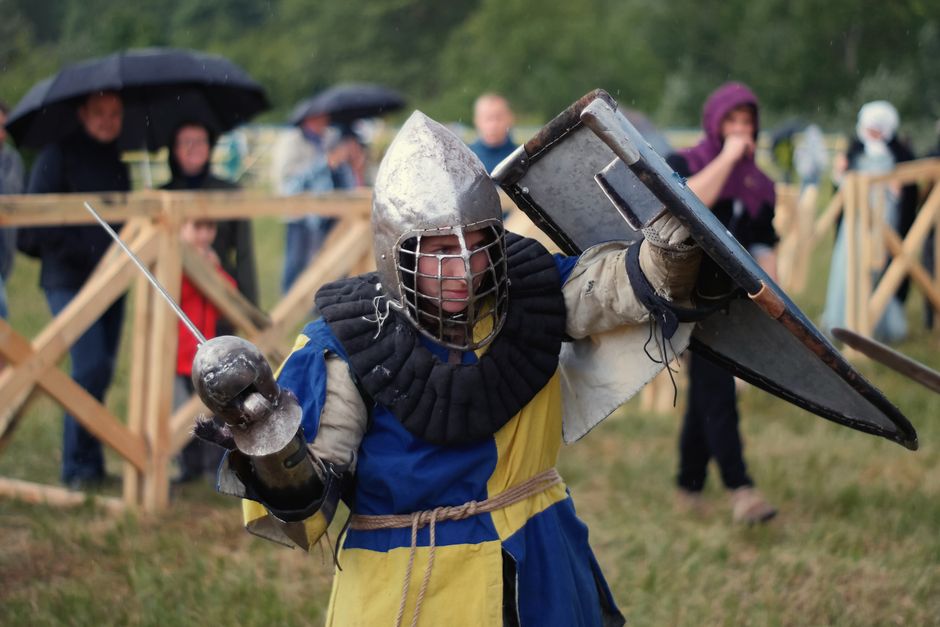 The armor is the detail that matters. Not because it is dramatic — because it is specific.
Somebody who told this story knew that plate armor and moving water do not negotiate. The legend was built by people who had seen a river take someone.
He throws the flowers. He says the words. He goes under.
And for roughly seven hundred years afterward, a flower in Europe has meant remember me because of a sentence shouted at the wrong moment.
Henry Bolingbroke picked it up next, which is where things get interesting. Exiled from England in 1398, he adopted the forget-me-not as his badge and paired it with the French motto Souveigne vous de moy.
 He was not being tender. He was reminding the English nobility that he existed and had a claim.
A year later he was Henry IV and Richard II was dead in Pontefract Castle. The gentlest flower in the hedgerow had worked as a calling card for a coup.
The Victorians took the politics out and put the sentiment back in. In the floral dictionaries that circulated through the 1840s and 1850s, forget-me-not sat in the true love category alongside myrtle and ivy.
Young people pressed them into letters. Soldiers carried them in pocket Bibles. The flower was cheap, it grew everywhere in England, and it said the one thing nobody could write down directly.
Then came the wars, and the meaning hardened.
 The German Freemasons chose it as their emblem in 1917. Under the Third Reich, with the lodges shut down, the pin became a way to recognize each other in public without being arrested.
After 1945 the lodges reopened and kept the flower. It had earned its place by being small enough to hide.
Alaska took it in the same year, for the opposite reason — not concealment but a plea for attention from a territory nobody in Washington was thinking about.
Now it belongs mostly to the dementia charities, and that transfer feels less like a rebrand than a homecoming. The flower was always about the fear of being forgotten, which is a different and older fear than death.
The knight did not ask to be saved. He asked to be remembered.
That is still the whole flower, in four syllables, in whatever language you grew up speaking.
2. Pink
Meaning: Young or tentative affection — the first stirring of love, before anything has been declared or tested.

💡 At a Glance
Shade Variations: Shell pink — the palest version, barely more than white with a blush. Reads as delicate and tends to vanish in photographs unless shot against something dark.
Rose pink — the cultivar standard, seen in Victoria Rose. A clean mid-pink that holds up in mixed plantings.
Dusty mauve-pink — what you get on a fading bloom mid-shift. This is the shade that shows up in antique botanical illustrations, partly because it is beautiful and partly because pressed flowers tend toward it.
Pink fading to lavender — the transitional shade on a stem actively turning. Short-lived and the most interesting of the group.
A practical note: pink forget-me-nots photograph warmer than they look in person. If you are planning a wedding palette around them, look at them in the actual light of the actual venue.
Stems & Styling: Pink forget-me-not is the better choice when the blue would be too heavy or too final.
Think first anniversary rather than silver. New relationship rather than reunion. The pink keeps the remembrance meaning but takes the grief out of it.
Pairings that work:
- Sweet peas — both flowers are wispy and slightly unruly, and together they make a bouquet that looks like it came out of a cottage garden rather than a cooler.
- White anemones — the dark centers give the arrangement contrast, which pale pink badly needs.
- Astilbe — texture for texture. Fluffy against tiny.
- Mixed pink and blue forget-me-nots — the honest option. Cut from a clump that is mid-shift and let the arrangement show both stages.
Avoid pairing pink forget-me-not with hot or coral pinks. The flower is too pale to compete and will read as dirty rather than soft.
For styling, pink wants a clear or pale vessel. Put it in dark ceramic and it disappears.
The pink ones are the flower before it has made up its mind.
That is close to literal. On most Myosotis plants, the bud opens pink and the petals turn blue over the following days as the chemistry inside them shifts.So a single clump in May is holding a timeline. New buds pink at the edges, mature flowers blue at the center, a few faded mauve stragglers on the way out.
The Victorians noticed this. They built an entire emotional vocabulary on flowers, and here was a plant that changed color on a schedule.
Pink got filed under young love. Blue got the vow.
It is a tidy distinction and it almost certainly came after the fact — somebody looking at a flower doing something interesting and reverse-engineering a meaning. But the meaning stuck because it is a decent metaphor.
Affection does start uncertain. It does deepen into something with a different color.The true pink cultivars came later, bred for gardeners who wanted the shade to hold. Victoria Rose is the one you have probably seen without knowing its name, in some National Trust border in a drizzle.
Purists grumble about them. Fixing the pink in place removes the thing the wild plant does best, which is to show you several stages of the same flower at once.
I am sympathetic to the grumbling. But the cultivars have a job the wild form cannot do, which is to be reliably pink on the one Saturday in May when somebody is getting married.That is where pink forget-me-not mostly lives now. Spring weddings, christenings, the first anniversary.
It carries the remembrance meaning without the weight of a deathbed promise. You can hand somebody pink forget-me-nots without implying that one of you is going into the river.
And there is one use that nobody planned and everybody understands. When British and American gardeners plant a memorial bed for a child, they reach for the pink.
No flower dictionary assigned that. It just turned out to be the shade that fit.
3. White
Meaning: Pure, uncomplicated remembrance — memory stripped of romance, often used for sympathy and spiritual devotion.> 💡 At a Glance
Shade Variations: Pure white — the cultivar standard. Clean, bright, and the easiest of all forget-me-nots to photograph well.
Cream white — a slightly warmer tone found in some seed-grown stock. Sits better with ivory and champagne palettes than the stark white does.
White with a blue vein — occurs in seedlings of white cultivars crossed back toward wild stock. Faint blue lines run through the petals. Collectors hunt for it; florists cannot order it.
White with a prominent yellow eye — technically the same flower, but when the center is unusually large it changes the whole read of the bloom from delicate to cheerful.
White forget-me-nots yellow faster than blue ones as they fade. Plan around it for events — cut them the morning of, not the day before.
Stems & Styling: White forget-me-not is the sympathy choice, and it is a genuinely good one because it says remembrance without saying grief.
For a funeral or memorial arrangement, use white forget-me-nots as the soft element among heavier flowers. White lilies and chrysanthemums do the formal work; the forget-me-nots keep the whole thing from looking institutional.
Pairings:
- White lily of the valley — both small, both white, both loaded with meaning. A restrained and expensive combination for memorial work.
- White stock or white sweet pea — adds scent, which matters more in a sympathy arrangement than people expect.
- Green hellebore or hosta leaves — the green keeps an all-white arrangement from reading as sterile.
- Blue forget-me-nots — mixing white and blue of the same flower is a quiet gesture. Reads as both grief and love without announcing either.
For weddings, white forget-me-not works beautifully in boutonnieres and hair pieces where blue would be too much of a color statement.
On count: for sympathy work, avoid even numbers in most European traditions and avoid thirteen everywhere. A generous loose handful is always safe and always has been.
The best story about white forget-me-nots is a garden at Kensington Palace.
In 2017, on the twentieth anniversary of Diana's death, the Sunken Garden there was replanted as a memorial. Among the white roses and sweet peas and dahlias, the planting list included forget-me-nots, which were reported as her favorite flower.That detail got a great deal of press and it is easy to see why. A woman defined in public memory by the fear of being forgotten, remembered with the flower that asks not to be.
Whether the favorite-flower claim is precisely documented or partly posthumous tidying, the planting happened and the garden is still there.
Which is the thing about white forget-me-nots. They end up in memorial ground more often than anyone plans.
Walk any older English churchyard in May and you will find them in the gravel, in the cracks between slabs, at the base of headstones nobody tends anymore.Nobody planted those. The plant self-seeds with real enthusiasm and churchyards are exactly the kind of neglected, semi-shaded, slightly damp ground it likes.
So you get an accident that reads as intention. A flower named forget me not, growing unassisted on graves.
The older religious strand of the story fits here too. In the creation legend, the flower is the one that spoke up — not for love, just to be named.
That is a more modest wish than the knight's, and the white forms carry it better than the blue do. Blue forget-me-not is about somebody in particular.White is about the general case. Remember that this happened. Remember that someone was here.
Florists know this instinctively, which is why white forget-me-nots turn up in sympathy arrangements where blue would feel too intimate for a colleague or an acquaintance.
And in hospice remembrance gardens across the US and UK, you will usually find both — the blue because the dementia charities put it there, the white because somebody on the committee understood that not every loss is a romance.
4. Purple / Violet
Meaning: Remembrance carried as a cause — collective memory, historical grief, and commemoration that outlives the individual.> 💡 At a Glance
Shade Variations: Violet-blue — the common alpine shade, where high-altitude light intensity deepens the pigment. Myosotis alpestris at elevation runs noticeably more purple than the same species in a garden bed.
True purple — rare in the wild, mostly a transitional stage or a cultivar artifact. When you find it, it is usually brief.
Lavender — the soft end, common in fading blooms. This is the shade that dominates in dried and pressed forget-me-nots, because drying shifts blues toward lavender almost universally.
Deep indigo-purple — some Myosotis scorpioides in cold, wet conditions throw unusually dark flowers. Water forget-me-not grown in genuinely boggy ground is darker than the catalog photo promised.
If you are specifying purple forget-me-not for an event, be warned: florists mostly cannot supply it as a distinct color. You are usually choosing between deep blue and a dyed substitute.
Stems & Styling: Purple forget-me-not is more useful as a symbol than as a cut flower, because the supply chain barely acknowledges it exists.
For commemorative use — a memorial service, an awareness event, an anniversary of a collective loss — the practical move is to use deep blue Myosotis and let the purple-adjacent tone do the work, or to use the designed emblem on printed material and plant the real flower.
Where you can get it, pairings:
- White roses — the standard commemorative pairing across European memorial tradition. Purple and white reads as dignified rather than sad.
- Deep purple anemones or hellebores — a tonal arrangement that stays serious without going black.
- Rosemary — not a flower, but rosemary is the other great remembrance plant in Western tradition, straight out of Hamlet. Putting rosemary and forget-me-not in the same arrangement is about as explicit as flower language gets.
- Lavender stems — picks up the lavender shade in the fading blooms and adds scent.
For commemorative plantings rather than bouquets, Myosotis alpestris is the species to ask for. It gives the darkest reliable color and it perennializes better in cold zones.
On April 24th, 2015, Yerevan put a flower on everything.
The centenary emblem of the Armenian Genocide was a purple forget-me-not, and the design brief was unusually explicit for a commemorative symbol.Black center: the past and the loss itself. Twelve purple petals: the twelve institutions and communities that kept Armenian memory alive through the century. Five yellow projections radiating out: the five continents where survivors ended up.
Every element was assigned. Nothing was left to interpretation.
That is a strange way for flower symbolism to come into existence. Most of it accumulates by accident over centuries — a legend, a Victorian dictionary, a war.
This one was commissioned.
And it worked, which is the interesting part. Eleven years on, the pin shows up every April from Glendale to Marseille, and people who have never read the design brief know what it means.The choice of forget-me-not was not arbitrary either. For a genocide whose recognition was denied for most of a century, a flower whose literal name is a demand to be remembered is about as pointed as symbolism gets.
Purple in the Western tradition already carried mourning and dignity. Roman imperial dye, Lenten vestments, half-mourning dress in the Victorian period after the black came off.
So the emblem stacked two things that already meant something.
The botany is less cooperative than the symbolism. True purple forget-me-nots are hard to come by, mostly appearing as transitional shades or in alpine species where altitude concentrates the pigment.Victorian alpine plant hunters chased Myosotis alpestris up Swiss and Austrian slopes for exactly this color, and the rock garden craze that followed is why British gardens have violet forget-me-nots at all.
If you ask a florist for purple forget-me-nots today, you will likely get deep blue and a shrug.
Which is fine. The purple forget-me-not is doing its work on lapels and posters rather than in vases, and it was built for that.
It is also drifted into Alzheimer's campaigns in several countries, where purple was already the awareness color and the blue flower simply changed outfits.
Two different kinds of forgetting, one flower, same demand.
5. Yellow (the eye) and Yellow-flowered species
Meaning: The constant heart — loyalty that holds steady while everything around it changes color.> 💡 At a Glance
Shade Variations: Golden yellow eye — the classic, found on most blue garden forget-me-nots. Bright enough to be visible from a distance in a mass planting, which is part of why a clump reads as cheerful rather than melancholy.
White eye — common in wild Myosotis scorpioides and many cultivars. Softer and more delicate than the yellow.
Cream-yellow throat fading to white — the transitional form, visible as the flower ages.
Pale yellow petals — Myosotis discolor at the opening stage. Cream to buttery, lasting only days before the shift to blue begins.
The eye size varies more than people notice. Some cultivars have been selected for a large prominent ring, which changes the flower's whole character from wistful to sunny.
Stems & Styling: You are not going to buy yellow forget-me-nots. What you can do is design around the eye, which is a genuinely useful florist trick.
Pair blue forget-me-nots with yellow flowers and the eye suddenly becomes the link holding the arrangement together. The effect is far stronger than it sounds on paper.
Best uses:
- Yellow narcissus or jonquil — spring-season match, and the yellow trumpet echoes the forget-me-not eye exactly. Cheap, cheerful, and seasonal.
- Yellow tulips — bolder and more structural. Good for a table arrangement that needs to read from across a room.
- Craspedia (billy buttons) — small yellow spheres against small blue flowers. Modern, graphic, and it lasts forever.
- Yellow ranunculus — the softest of the yellow options and the most wedding-appropriate.
For symbolism, a blue-and-yellow forget-me-not arrangement reads as loyal and bright rather than mournful. This is the version to send for a graduation or a recovery, not a funeral.
If you are growing them, plant blue forget-me-nots as underplanting for yellow daffodils. It is the single most reliable spring combination in temperate gardening and it has been for two centuries.
Look at a forget-me-not closely enough and the flower stops being blue.
There is a ring at the center — yellow in most garden varieties, white in some wild ones — and once you see it you cannot unsee it.Victorian flower writers built a whole reading on that ring. The petals change color as the flower ages, pink to blue to lavender. The eye stays put.
So: the steadfast heart. Devotion that holds while circumstances shift around it.
It is a little neat, as Victorian flower readings tend to be. But it is also just accurate about the plant, and that is more than you can say for most floral symbolism.
There is one forget-me-not that takes the color change to its limit. Myosotis discolor opens pale yellow — genuinely cream — and turns blue over a matter of days.It is a scruffy little European weed, now naturalized across North America, and essentially nobody notices it. Botanists like it because the pH-driven pigment shift is so dramatic that it works as a classroom demonstration.
The rest of us walk past it on roadsides every spring.
The practical legacy of the yellow eye is a gardening habit. Plant blue forget-me-nots under yellow daffodils and the whole bed clicks.Jekyll pushed this combination in her writing, Edwardian bedding schemes ran with it, and a century later it is the default spring planting in British front gardens and American botanical display beds alike.
The reason it works is the eye. The yellow in the daffodil trumpet and the yellow in the forget-me-not center are talking to each other across a difference in scale of about fifty to one.
That is also the move to steal for a bouquet. Blue forget-me-nots with yellow narcissus, or with craspedia if you want something more modern.
It turns the flower's meaning warm. Blue forget-me-not alone leans elegiac. Add yellow and it reads as loyal and glad about it.
Which is the version I would send to somebody graduating, or recovering, or moving far away. Remembrance that is not also grief.
Gift Guide by Occasion
1. Long-distance goodbye (someone moving away, deploying, or starting school abroad)
This is the flower's native habitat, occasion-wise. Skip the cut bouquet — it wilts in transit and they are packing boxes anyway.
Instead give seed packets plus a small potted clump, or a pressed-flower bookmark. Forget-me-nots press beautifully and keep their blue for decades, which a bouquet cannot do.
If you do want fresh flowers for the airport or the station, keep it small: a hand-tied posy of blue forget-me-nots and white sweet peas, wrapped in paper rather than cellophane. It should be carryable in one hand with a suitcase in the other.
2. Sympathy and memorial services
Use white or mixed white-and-blue, and send them as part of an arrangement rather than alone — the stems are too fine to stand up to formal funeral work on their own.
The strongest combination for memorial purposes is forget-me-not with rosemary. Rosemary is the Western remembrance herb going back to Shakespeare, and pairing the two is unmistakable without being heavy-handed.
For a dementia-related death, blue forget-me-nots carry real weight because of the charity association — the family will almost certainly recognize it. Say so on the card: name the flower and why you chose it. Flower meanings only work if the recipient knows the code.
3. Alzheimer's and dementia awareness events, or a diagnosis in the family
Blue forget-me-nots, and lean into it. This is the single clearest contemporary meaning the flower has.
For a fundraising event, mass potted plants beat cut stems — they cost less, they look better en masse, and guests can take them home and plant them. The Alzheimer's Society in the UK and equivalent organizations elsewhere sell forget-me-not pins and plants directly, so sourcing is easy.
For a family facing a new diagnosis, a planted container of Myosotis sylvatica for the doorstep is better than a bouquet. It comes back every spring and it self-seeds, which is a kinder metaphor than a vase of flowers going brown on the counter.### 4. Weddings and engagements
Forget-me-nots are a filler flower with a message, and that is precisely their wedding use. Thread them through the bridal bouquet, use them in boutonnieres, tuck them into hair pieces and napkin ties.
Practical warnings: they are seasonal (April to June in temperate zones), they wilt faster than roses, and they do not survive a hot marquee. Have the florist condition them in cold water overnight and assemble the morning of.
The meaning fits an engagement better than a wedding, strictly speaking — remembrance and fidelity read as a promise rather than a celebration. If somebody in the family has died, a few forget-me-nots pinned inside the bouquet wrap is a traditional and well-understood way to include them.
5. Veterans' remembrance and national commemoration days
Regionally specific, so check before you commit. In Newfoundland and Labrador the forget-me-not predates the poppy for war remembrance and is still worn on July 1st for Beaumont-Hamel.
For Armenian commemoration on April 24th, the purple forget-me-not emblem is the correct and expected symbol.
Elsewhere in the Commonwealth the poppy dominates November, and bringing forget-me-nots to a Remembrance Day service will read as a well-meaning mistake. If you want to use them for a personal rather than public remembrance — a grandparent's grave, a private anniversary — they work anywhere and always have.
6. Anniversaries, especially the first and the long ones
Pink for a first anniversary, blue for anything past a decade. The pink keeps it light; the blue says the promise held.
A good move for a milestone anniversary: plant them. A forget-me-not patch in the garden self-seeds indefinitely and comes back every spring without being asked, which is a better anniversary metaphor than almost anything you can buy cut.
For a bouquet, nine stems woven through white garden roses is the formal version. European florist tradition reads nine as lasting or eternal, and the blue-on-white is genuinely beautiful.
7. Graduation, recovery, or a new chapter
Go blue with yellow — forget-me-nots with narcissus, yellow tulips, or craspedia. The yellow flips the flower's tone from elegiac to warm, and the yellow eye at the center of each bloom ties the arrangement together visually.
The message reads as I remember who you were through this and I am glad about where you are going, which is a more useful sentiment than a generic congratulations bouquet.
For a hospital discharge or recovery milestone, send a planted pot rather than cut flowers. Many hospitals restrict cut flowers on wards anyway, and a plant that blooms next spring is the better gesture.
The Greeks and Romans did not have much to say about forget-me-nots, which is unusual for a flower this symbolically loaded. The genus name Myosotis is Greek — mouse's ear, for the fuzzy leaves — and Pliny the Elder mentions borage-family plants medicinally, but no god turns into one and no nymph dies beside one.
The flower's mythology is medieval and Northern instead. The German drowning-knight legend is the engine of the whole thing, and it spread with remarkable speed across language borders — the common name translates identically in German, French, Italian, Dutch, Swedish, Czech, and Welsh.
That near-universal translation is the real evidence. When a flower name means the same sentence in a dozen unrelated languages, the story crossed Europe faster than the plant trade did.
England gave it politics. Henry Bolingbroke adopted the forget-me-not as his badge during exile in 1398, paired with the motto Souveigne vous de moy. A year later he was Henry IV, and the gentlest flower in the hedgerow had served as the emblem of a successful usurpation.
The Victorians then stripped out the politics and installed sentiment. In the floriography boom of the 1840s and 50s — driven by Charlotte de la Tour's Le Langage des Fleurs and its many English imitators — forget-me-not landed firmly in the true love column, pressed into letters and tucked into lockets by a generation that could not say anything directly.
The twentieth century weaponized it twice. German Freemasons adopted it in 1917 and wore it as a covert identifier after the Nazi ban on lodges. Alaska claimed it the same year as a territorial emblem, a plea for attention from the far edge of the map, and kept it at statehood in 1959.
Since the 1990s the dominant Western meaning has shifted again, toward memory loss rather than absence. Alzheimer's and dementia charities across the UK, Ireland, Canada, and Australia use the forget-me-not as their primary symbol, and that association has largely overtaken the romantic one in public recognition.
It is the rare case of a flower meaning getting more literal over time. The knight meant remember me after I am gone. The modern use means remember, full stop — and nobody had to translate it.
-
Cut them in the morning, use them the same day. Forget-me-nots are among the shortest-lived cut flowers in the spring garden — expect three to five days in a vase, not a week. Cut while the dew is still on them and the stems are fully hydrated.
-
Strip the lower leaves and use a narrow vessel. The stems are thin and floppy and will collapse in a wide vase. A small jug, a jam jar, or a bud vase gives them something to lean on. Leaves left below the waterline will foul the water within a day.
-
Cold water, changed daily, no exceptions. Boraginaceae stems go slimy fast. Change the water every single day and re-cut a few millimeters off the stems each time — this one habit roughly doubles the vase life.
-
Keep them out of sun and away from fruit. Direct light cooks them and ethylene from ripening fruit makes them drop. A cool windowsill out of direct sun is ideal; anywhere near a fruit bowl or a radiator is not.
-
For garden plants: let them go to seed and then rip them out. Myosotis is a biennial or short-lived perennial that self-seeds aggressively. Leave the spent plants until the seed sets, then pull the whole lot — they turn to grey mildew in summer heat and look terrible. Next spring's crop is already in the soil.
-
Press the ones you want to keep. Forget-me-nots hold their blue in pressing better than almost any other flower, for decades. Flat between absorbent paper under weight for two weeks, no fancy equipment needed. This is why they show up in Victorian letters still blue a hundred and fifty years later.
📌 Quick Summary
-
Blue — Faithful love and enduring remembrance — the flower's signature meaning and the color behind nearly every legend attached to it.
-
Pink — Young or tentative affection — the first stirring of love, before anything has been declared or tested.
-
White — Pure, uncomplicated remembrance — memory stripped of romance, often used for sympathy and spiritual devotion.
-
Purple / Violet — Remembrance carried as a cause — collective memory, historical grief, and commemoration that outlives the individual.
-
Yellow (the eye) and Yellow-flowered species — The constant heart — loyalty that holds steady while everything around it changes color.
More Flower Meanings
I think the reason this flower stuck is that its name is a request, and almost no other flower's is.
Roses are named for roses. Daisies for the day's eye. Chrysanthemums for being gold.
Forget-me-not is a sentence somebody said, to somebody else, who then had to live with it.
That is why it keeps getting adopted — by a usurper in exile, by Freemasons hiding from the Gestapo, by a territory nobody in Washington was thinking about, by Armenians waiting a century for the word genocide, by families watching someone lose their memory in real time.
All of them needed the same four syllables. The flower was already saying it.
It also happens to be a tough little plant that seeds itself into churchyard gravel and comes back every April without being asked.
Which may be the most honest part of the symbolism. The remembering does not take any particular effort once it is established.
You just have to not pull it out.


댓글
댓글 쓰기