Peony Meaning: What Every Color Says, From Ancient Greek Myths to Modern Bouquets
A single peony plant can outlive the person who planted it.
Some specimens in gardens across England and New England have been blooming for over a hundred years, returning every May like clockwork.
The ancient Greeks named it after Paeon, a healer who angered his teacher so badly that Zeus had to turn him into a flower to save his life.
That origin story tells you everything about the peony — beauty born from drama, softness wrapped around something fierce.
Today, peonies remain one of the most requested flowers for weddings, the unofficial star of every spring garden, and a bloom whose color carries meaning most people never learn.
This guide breaks down peony meaning by color, with the myths, history, and real-world stories behind each one.
🌸 Flower Profile
| Scientific Name | Paeonia lactiflora (herbaceous) / Paeonia suffruticosa (tree peony) |
| Family | Paeoniaceae |
| Origin | Southern Europe and temperate Asia — cultivated extensively in China, later brought to European and American gardens |
| Blooming Season | Late spring to early summer (May through June) |
| Primary Meaning | Prosperity, romance, honor, and bashfulness |
Color Meanings
Table of Contents
1. Pink
Meaning: Romance, prosperity, and good fortune

💡 At a Glance
Shade Variations: Pale baby pink leans toward innocence and gentle affection — perfect for a first date or a new friendship.
Medium rose pink is the classic romance shade, carrying the full weight of the flower's love symbolism.
Hot pink or magenta peonies (like the variety Karl Rosenfield) shift the tone toward celebration and boldness.
They say confidence rather than bashfulness.
Dusty pink or mauve-pink varieties feel nostalgic and vintage, making them favorites for rustic weddings.
Stems & Styling: An odd number of stems reads as intentional in Western tradition — three stems for a focused romantic gesture, five or seven for a fuller arrangement.
Pink peonies pair beautifully with garden roses, ranunculus, and dusty miller foliage.
For a spring wedding bouquet, try mixing pale pink peonies with white sweet peas and a few sprigs of jasmine vine.
Keep stems long and loose for an English garden feel.
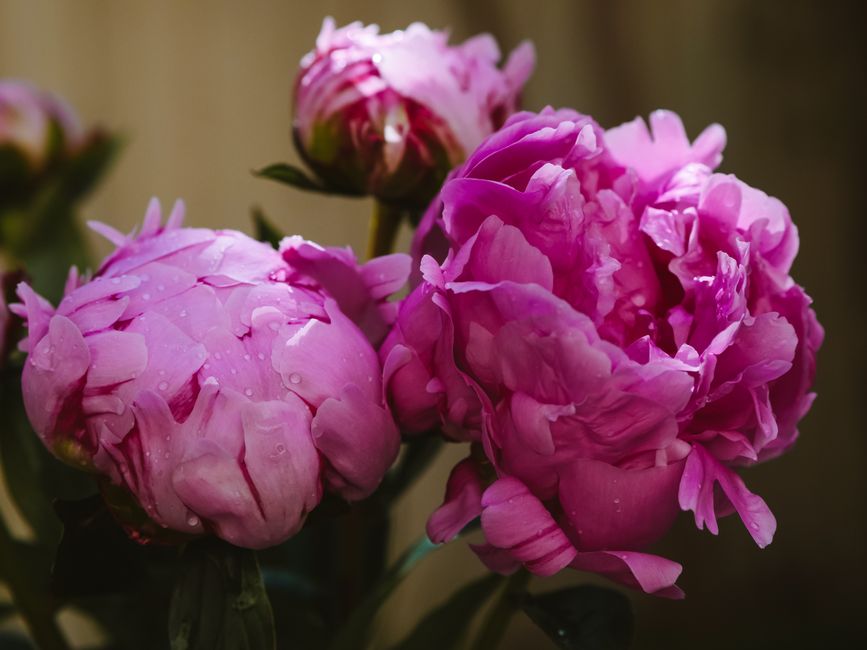
The pink peony is the flower people picture when they hear the word peony.
It is the default, the classic, the one that sells out at farmers markets by 8 a.m. on Saturday mornings.
 There is a reason for that dominance.
Pink sits at the exact midpoint between passion and tenderness.
It does not shout like red or whisper like white.
It speaks at a normal volume, and what it says is both warm and assured.
The Victorians understood this.
They built an entire vocabulary around flowers, and the pink peony earned one of the most complex entries — bashfulness meeting bravery.
A suitor would send pink peonies to a woman he admired but could not yet approach directly.
The flowers said what propriety would not allow him to.
 Today, pink peonies carry that same emotional weight without the formal rules.
They show up at weddings more than almost any other bloom.
Martha Stewart built part of her lifestyle empire around them, photographing her own peony garden for magazine covers year after year.
Designers at Oscar de la Renta and Carolina Herrera have used pink peony motifs on gowns and runway sets.
The flower crossed from gardens into culture and never came back.
 If you grow them at home, the variety Sarah Bernhardt — named after the legendary French actress — is the most reliable producer of that perfect medium-pink, heavily ruffled bloom.
Plant it in full sun, give it three years to establish, and it will reward you for decades.
Maybe longer than decades.
Some Sarah Bernhardt plants from the early 1900s are still flowering today.
2. White
Meaning: Elegance, purity, and new beginnings
💡 At a Glance
Shade Variations: Pure bright white (like the variety Festiva Maxima, which has tiny crimson flecks at the center) is the most traditional bridal choice.
Ivory or cream-white peonies feel warmer and pair well with gold accents and candlelight.
White with a blush center — sometimes called the gardenia effect — adds dimension without adding color.
These are the varieties that photograph best in soft natural light.
Stems & Styling: White peonies are statement flowers.
A bouquet of five to nine stems of pure white peonies, loosely gathered with their own foliage, needs nothing else.
If you want to build out, add white ranunculus, lily of the valley, or stephanotis.
Avoid mixing in anything too bright — the elegance of white peonies comes from restraint.
For sympathy arrangements, pair white peonies with eucalyptus and white stock for a soothing, dignified look.
White peonies have a quality that other white flowers struggle to match.
They are soft without being fragile.
Their petals fold inward in layers — dozens of them — creating depth that catches light differently at every angle.
The Greek myth gives them a sacred origin.
Paeon, the gifted healer, plucked a peony root from Mount Olympus to cure Hades of a battle wound.
His teacher Asclepius, furious with jealousy, threatened to kill him.
Zeus intervened by transforming Paeon into the flower itself — white, radiant, and beyond harm.
That story shaped how Europeans thought about peonies for centuries.
Monks grew them.
Painters placed them in scenes of divinity.
The bridal connection solidified in the 1800s, when Queen Victoria's era turned flowers into a language and white became the definitive wedding color.
White peonies offered something roses could not — volume.
A single peony head can measure six inches across.
Three stems fill a bouquet the way a dozen roses would.
Modern brides know this, which is why white peonies command premium prices in May and June — sometimes $8 to $12 per stem at peak season.
The variety Duchesse de Nemours is a florist favorite.
It opens creamy yellow and fades to pure white, smelling faintly of citrus.
If you want that timeless wedding look without the peak-season price, this is the cultivar to request by name.
3. Red
Meaning: Passion, honor, and deep respect
💡 At a Glance
Shade Variations: True crimson red (like Red Charm) is bold and unambiguous — it reads as passion and commitment.
Dark burgundy-red (like Buckeye Belle) feels more serious and distinguished, closer to honor than to romance.
Cherry red varieties are brighter and more festive, suitable for celebrations.
Wine red or oxblood peonies have a moody, dramatic quality that works well in autumn-toned arrangements, even though peonies are a spring flower.
Stems & Styling: Red peonies make a powerful statement.
Keep arrangements simple — three to five stems in a clear vase, letting the color do the work.
They pair well with deep green foliage like camellia leaves or dark berries for contrast.
For a romantic dinner arrangement, combine red peonies with burgundy dahlias and a few stems of astilbe.
Avoid mixing with other bright colors — red peonies want to command the room.
Red peonies occupy a different emotional register than red roses.
Where a rose says I love you, a red peony says I honor you.
The distinction matters.
This flower's red carries weight.
It is not the bright, almost aggressive red of a long-stemmed rose.
It is deeper, more layered, with petals that fold into shadow.
The French understood this.
Empress Josephine grew red peonies at Malmaison, her estate outside Paris, during the early 1800s.
She was building what would become the most famous garden in Europe, and red peonies earned their place alongside her beloved roses.
Manet painted them.
His 1864 still lifes featuring peonies are some of the most reproduced flower paintings in Western art.
The red blooms in those paintings practically vibrate — he captured the way a red peony seems to glow from inside, as if the color is generated rather than reflected.
Today, red peonies are the thinking person's Valentine's flower.
They say something more specific than a dozen red roses ever could.
They say: I see you clearly, and what I see deserves respect.
The variety Red Charm is the gold standard — a bomb-type bloom that opens into a massive sphere of layered crimson petals.
It was hybridized in 1944 by Lyman Glasscock, and it still wins awards at peony shows eight decades later.
Some things do not need improving.
4. Coral
Meaning: Warmth, sincerity, and joyful affection
💡 At a Glance
Shade Variations: True coral (like Coral Charm, the most famous variety) shifts color as it opens — starting deep coral and fading to soft peach over several days.
Salmon-coral leans more orange and feels energetic and modern.
Soft coral-pink is gentler, almost like a warm blush, and works beautifully in spring palettes.
Deep coral approaches terracotta territory and pairs well with earth tones and dried grasses.
Stems & Styling: Coral peonies are inherently cheerful, so lean into that energy.
Mix them with peach garden roses, chamomile, and golden wheat stems for a sun-drenched, organic look.
A bouquet of five coral peonies with trailing jasmine vine makes an exceptional hostess gift.
For weddings, coral peonies have become the signature flower of the boho-romantic aesthetic — pair with terracotta ribbons and pampas grass accents.
Coral is the color of a sunset caught in petals.
That sounds dramatic, but look at a Coral Charm peony in its second day of bloom and you will understand.
This variety does something almost no other flower does.
It changes color as it opens.
Day one: deep, saturated coral, almost mango-toned.
Day two: softer, peachy, glowing.
Day three: pale apricot with just a memory of warmth.
It is a flower that contains its own time-lapse.
The meaning people attach to coral peonies reflects this warmth.
They are the flower of sincere happiness — not the complicated passion of red, not the bashful sweetness of pink.
Coral says: I am glad you exist.
When Pantone named Living Coral the 2019 Color of the Year, florists already knew.
Coral Charm had been gaining ground for a decade, and that announcement turned it into the most requested peony variety in the world.
Orders tripled.
Growers could not keep up.
If you can find them at your local market between late May and mid-June, buy every stem available.
They disappear fast.
And no photograph fully captures what happens when coral petals catch the light from a west-facing window at golden hour.
That, you have to see for yourself.
5. Yellow
Meaning: New beginnings, good fortune, and friendship
💡 At a Glance
Shade Variations: Bright lemon yellow (like Bartzella, the most celebrated Itoh hybrid) is sunny, optimistic, and unmistakable.
Soft butter yellow feels gentler and pairs well with whites and creams.
Golden yellow leans toward amber and carries a richer, almost autumnal warmth despite being a spring bloomer.
Pale primrose yellow is the subtlest shade — barely there, like morning light on white sheets.
Stems & Styling: Yellow peonies are rare and expensive — expect to pay $15 to $25 per stem for Itoh varieties.
Because of the cost, use them as focal flowers.
Three stems of Bartzella with white stock and trailing greenery makes a striking, high-impact arrangement.
For friendship bouquets, pair yellow peonies with sunflowers, chamomile, and lemon leaf for a joyful, sun-soaked look.
Yellow peonies also work as a single stem in a bud vase on a desk — an understated luxury.
For most of peony history, yellow was the color that did not exist.
Pink, white, red — those were the options.
Yellow was a rumor, a dream, a goal that hybridizers chased for decades.
The breakthrough belongs to Toichi Itoh, a Japanese horticulturist who spent years crossing herbaceous peonies with tree peonies.
Most attempts failed.
The two types were considered too genetically distant to produce viable offspring.
Itoh succeeded in the 1960s but died before seeing his hybrids bloom.
His family and colleagues carried the work forward, and the results changed the peony world permanently.
The variety Bartzella — named by American hybridizer Roger Anderson — became the ambassador for the entire category.
Its blooms are enormous: bright lemon yellow, lightly fragrant, with a faint red flare at the base of the petals.
It won the Gold Medal.
It appeared in magazines.
It made gardeners who had never cared about peonies suddenly care very much.
Yellow peonies mean new beginnings — which makes sense for a flower that had to be invented.
They are also associated with friendship and good fortune.
Sending yellow peonies to someone starting a new chapter — a new job, a new home, a fresh start after something difficult — is one of the most thoughtful flower gestures you can make.
Just be prepared for the price tag.
Rarity has its costs, and yellow peonies earn every dollar.
6. Purple
Meaning: Royalty, enchantment, and dignity
💡 At a Glance
Shade Variations: Soft lavender (like the variety Do Tell) is playful and whimsical, closer to charm than to gravitas.
Deep plum (like Paul M. Wild) is serious, moody, and intensely photogenic.
Mauve-purple sits between pink and true purple, offering a sophisticated, muted quality.
Dark burgundy-purple (like Walter Mains) is the most dramatic — nearly black in certain lights, theatrical and unapologetic.
Stems & Styling: Purple peonies are scene-stealers.
Build the arrangement around them, not alongside them.
Three to five deep purple stems with silver-toned foliage (dusty miller or eucalyptus) and white accent flowers create a formal, striking display.
For a moodier aesthetic, pair dark purple peonies with black dahlias, chocolate cosmos, and deep green ferns.
Purple peonies in a dark ceramic vase on a dining table set the tone for an entire evening.
Purple has always been the color of people who refuse to blend in.
Emperors wore it.
Princes killed for it.
And in a peony garden, the purple blooms are the ones that stop you mid-step.
The connection between purple and power is not metaphorical.
It is economic.
For thousands of years, purple dye cost more than gold by weight.
The Phoenicians extracted it from sea snails — thousands of snails for a single gram of pigment.
Roman law made it illegal for anyone below senatorial rank to wear a fully purple garment.
The color was literally restricted by legislation.
Flowers inherited this symbolism wholesale.
A purple peony in a Victorian garden whispered what the gardener could not say aloud: I am someone of substance.
The darker the purple, the stronger the statement.
Today, deep purple peonies like Paul M. Wild are the darlings of editorial photography.
Their near-black centers create dramatic contrast against lighter backgrounds.
Fashion houses use them.
Wedding planners hoard them.
If you want to grow them, Paul M. Wild needs patience — it takes three to four years to establish fully — but the payoff is a bloom so deeply saturated it looks almost artificial.
It is not.
That color is earned, not engineered, produced by layers upon layers of pigmented petals folding over each other until the light cannot escape.
There is a reason emperors chose this color.
Some things are worth the wait and the cost.
7. Blush
Meaning: Grace, tenderness, and quiet adoration
💡 At a Glance
Shade Variations: Palest blush (like Gardenia) is nearly white with just a breath of warmth — elegant and bridal.
Soft blush pink (like Angel Cheeks) has more visible color, reading as romantic without being overtly so.
Peachy blush leans toward apricot and feels modern and fresh.
Blush with deeper pink edges (like some Eden's Perfume blooms) creates a watercolor effect that florists prize.
Stems & Styling: Blush peonies are the diplomats of the flower world — they complement everything.
Mix them with ivory roses, white astilbe, and soft greenery for an effortlessly romantic bouquet.
For baby showers, combine blush peonies with lavender sweet peas and pale blue delphiniums.
Seven to nine blush peony stems gathered loosely with silk ribbon in a muted tone makes a gift bouquet that looks far more expensive than it is.
They photograph beautifully in any light — a major reason they dominate wedding Pinterest boards.
There is a specific shade of pink that barely qualifies as pink.
It is the color of light through a seashell.
The inside of a conch held up to a window.
That is blush, and when a peony blooms in that shade, it becomes one of the most quietly beautiful things in nature.
Blush peonies do not demand attention the way red or coral ones do.
They earn it through subtlety.
The Victorians would have approved.
In an era when the volume of a compliment mattered, blush was the whisper that carried farther than a shout.
It said: I notice you, and what I notice is lovely.
Pippa Middleton chose blush peonies for her 2017 wedding.
The arrangements were photographed by every major publication in the world.
They looked effortless — which is the hardest aesthetic to achieve and the most expensive to buy.
Jo Malone understood the appeal well enough to bottle it.
Their Peony & Blush Suede fragrance became a phenomenon, blending peony notes with soft leather and jasmine.
It smells exactly like this flower looks: gentle, warm, and impossible to forget once you have noticed it.
In the garden, the variety Gardenia delivers this shade reliably.
It is a bomb-type double with hundreds of petals that open into a dome of creamy blush.
The name is apt — it has the same luxurious, full-petaled quality as an actual gardenia, but in peony form.
Plant it where morning sun hits first.
That is when blush peonies look their absolute best — backlit, translucent, glowing from within like something out of a Vermeer painting.
Gift Guide by Occasion
1. Wedding
Peonies are arguably the most popular wedding flower of the last two decades. Choose white or blush for classic elegance, coral for a bohemian or garden-style celebration, or mix pink and white for romantic versatility. Order well in advance — peonies are seasonal (May–June) and sell out fast. If your wedding falls outside peony season, ask your florist about sourcing from Southern Hemisphere growers (available November–January) or using high-quality silk alternatives.
2. Anniversary
Match the color to the milestone. Pink peonies for early anniversaries (first through fifth) signal growing love. Red peonies for a tenth or twentieth anniversary convey deep, established devotion. Yellow peonies (Itoh hybrids) for a twenty-fifth or fiftieth make a statement about renewed joy and rarity — especially fitting for a relationship that has lasted.
3. Mother's Day
Pink or blush peonies are the gold standard for Mother's Day — warm, nurturing, and universally loved. A bouquet of five to seven stems with simple greenery needs no card to communicate its message. Timing works perfectly since Mother's Day in May coincides with peak peony season. Order from a local grower if possible — freshness matters enormously with peonies.
4. Apology
White peonies paired with a handwritten note. The flower's association with sincerity and fresh starts makes it more effective than roses for an apology, which can feel performative. Keep the arrangement simple — three to five stems. Extravagance undercuts the message when you are asking for forgiveness.
5. Get Well or Recovery
Coral or soft pink peonies bring warmth and optimism without the heaviness of more dramatic colors. Their full, rounded blooms have a comforting quality. Send them in a vase rather than wrapped — the recipient should not have to do any work. Add a few stems of fragrant herbs like mint or lemon balm if the person enjoys scent.
6. New Baby
Blush peonies for a girl, soft yellow or white for a boy, or a mix for a gender-neutral celebration. Peonies represent prosperity and good fortune — a meaningful wish for a new life. Keep arrangements low-profile and lightly scented, as strong fragrances can overwhelm a nursery.
7. Housewarming
Yellow or coral peonies signal warmth, optimism, and good fortune in the new space. Present them in a ceramic vase the recipient can keep — it doubles the gift. A potted peony plant is even better for someone with a garden, since it will bloom for them every spring for years to come.
The Myth of Paeon
The peony's name traces directly to Paeon, a figure from Greek mythology.
Paeon was a student of Asclepius, the god of medicine.
When Paeon used a peony root to heal Hades (or, in some versions, Ares) of a wound sustained during the Trojan War, Asclepius grew violently jealous.
He threatened to kill his student.
Zeus, recognizing Paeon's gift, intervened by transforming the healer into the flower that had saved a god.
The myth embedded healing, protection, and divine beauty into the peony's identity from the very beginning.
Victorian Flower Language
In the 1830s and 1840s, when floriography swept through England, the peony earned a prominent entry in every flower dictionary.
Its primary meaning was listed as bashfulness — a trait the Victorians found charming rather than weak.
The idea was rooted in a folk belief that nymphs hid among peony petals and would blush if discovered.
Sending peonies during this era was a nuanced social act: it acknowledged beauty while respecting modesty.
The double-layered message — boldness in sending, bashfulness in meaning — made peonies a favorite among suitors navigating the strict social codes of the time.
Peonies in Western Art and Literature
Peonies appear throughout Impressionist painting, most notably in the works of Édouard Manet, who painted them repeatedly in the 1860s.
His still lifes capture the flower at its most fleeting — full, heavy, on the verge of dropping petals.
In literature, peonies appear in the poetry of Mary Oliver and the garden writing of Vita Sackville-West, who grew them at Sissinghurst Castle in Kent.
Sackville-West described them as flowers that managed to be both voluptuous and dignified — a combination she found irresistible.
-
Cut stems at an angle before placing them in water — this increases the surface area for water absorption and keeps stems from sitting flat on the vase bottom.
-
Use cool, clean water and add commercial flower food if available. Change the water every two days to prevent bacterial growth, which is the primary killer of cut peonies.
-
Remove leaves below the waterline — submerged foliage decays quickly and clouds the water. Leave upper leaves intact for a natural look.
-
Keep peonies away from direct sunlight and heat sources once cut. They will open faster in warmth, which shortens their vase life. A cool room extends bloom time by two to three days.
-
Buy peonies in bud stage — they should feel like soft marshmallows when gently squeezed. Rock-hard buds may never open. Already-open blooms will last only a day or two in a vase.
-
If buds are slow to open, place stems in warm water and position the vase in a sunny spot for a few hours. The warmth encourages petals to unfurl. Once open, move them back to a cool location.
📌 Quick Summary
-
Pink — Romance, prosperity, and good fortune
-
White — Elegance, purity, and new beginnings
-
Red — Passion, honor, and deep respect
-
Coral — Warmth, sincerity, and joyful affection
-
Yellow — New beginnings, good fortune, and friendship
-
Purple — Royalty, enchantment, and dignity
-
Blush — Grace, tenderness, and quiet adoration
A peony does not last long once cut.
Five days, maybe seven if you are lucky and keep the water clean.
But that brevity is part of the point.
Peonies teach the same lesson every May — that the most extraordinary things are often the least permanent.
The gardens that have been growing them for a century know this.
The brides who build their entire wedding aesthetic around a flower available for six weeks a year know it too.
Choose the color that matches what you mean.
Give them to someone who matters.
And pay attention while they bloom, because they will not wait for you to notice.


댓글
댓글 쓰기